15 November 2008

Standardizations


With our 'merican sensitivity to "difficult" math, you might think we'd be less reluctant to adopt some standards that would make our lives a little easier.  I'm talking about a conversion to the metric system.   Measuring in mL, cm, and g would take a little bit of work at first - some rewriting of recipes, some new traffic signs, and a couple generations who would internally translate mL back to cups.   Fine.   But the mark of fluency is the ability of think in a new language without internally translating.  We could get there.  Besides, there is a lot of appeal in powers of ten.  I love conversion factors more than most, but even I dig the quick conversion from grams to kilograms or millimeters to centimeters.  1 mi = 5280 ft. 1 gal = 128 oz. or is it 96? 16 c.?  And is a cup 8 oz?  See what I mean?  I know the answers to these, but go ahead - ask ten people on the street, and good luck.

Why the stubborn adherence to the arbitrary?  I mean, every other country in the world uses paper with a fixed aspect ratio; it just makes sense for enlarging/reducing.  Why do we have to make it difficult for ourselves with legal and letter?

I teach in metric because it's the standard of international science.  But I can only do so much to prompt the revolution.  Can I get some help here, please?


Originally drafted 7 July 2008

13 November 2008

Playbill

Jennifer (Witch 1).  Jennifer is happy to be appearing on stage again, this time in The Complete Works of William Shakespeare, Abridged.  Previously cast in motherly roles, she plays one of Macbeth's witches - a role for which she says teaching has prepared her.  Favorite roles include Debbie in American Beauty, Messenger in The Wiz, and orchestral credits in Lessons and Carols.  Love and kisses to her adoring public!

12 November 2008

Tree Frog


I took a picture of this frog on our bathroom window two months ago. It seems a nice accompaniment to Jess's post. I didn't name it. Maybe I should.

05 November 2008

On the Nature of Incremental Change

I've recently seen photographs of several friends and acquaintances I haven't seen, in person, in at least ten years.  (mostly a result of certain social-networking sites)  Clicking through their photos, I'm struck by how much they look like grownups.  I'm not saying they haven't aged well - it's just that they don't look like they're in high school or college anymore.  My mental image of them hasn't changed since I last saw them, but obviously, we've all gotten a decade older.   Same thing happens with my cousins - and they're young, which amplifies the phenomenon - my mental images of them are as toddlers, but they're in upper elementary school now. Anyhow, when I look at pictures of myself, I don't marvel at how different I appear from ten, fifteen years ago. I mean, I know I've changed, but I've been present for the changes.  It isn't until I see a photo from 1997 and I can't help but notice how much younger I appear.  And that's not entirely true either.  When I look at that photo from 1997, what catches my eye is how much younger the other people appear.  Only then do I think, "oh, yeah, me too".

I don't mean for this post to come across as a lament of the aging process - I don't have a problem with growing older.  What's interesting is my tendency to not age-progress individuals, and how surprised I am when I see that they're adults now.  It's clearly a function of how often I see someone.  Incremental change on the order of days or months is significantly smaller (and less noticeable) than that on the scale of years, even decades.
The shift of plates goes unnoticed until a dramatic event.
There's another strange time phenomenon going on in my head. I occasionally manage to neglect a four-year chunk of my life, the California Years.  From time to time, I simply forget we lived there.  I remember the people and the places, but sometimes, when I'm going through my mental timeline, I find I just close the gap between college and Florida.  This happened most noticeably the year I spent advising college-bound high-school seniors.  The more I talked about college and thought about what it was like to go off to college, the time gap between now and then started to shrink; when I caught myself, it was with marvel that there was a chunk of four years (and even a couple years here) that I just glazed right over as though they were insignificant.  Which they weren't.
Time is a transparent film, stretching and shrinking.
I was asked recently, on the occasion of my ninth wedding anniversary, how my marriage had changed over time.   It was a more difficult question than I expected it to be.   I know there has been change, but I can't articulate it, and I certainly can't divorce it from our own individual changes.  It's a kind of relative-motion frame-of-reference problem, because our relationships evolve as we are changing, too.
A person walks at a speed of 2 m/s relative to a moving sidewalk. If the sidewalk is moving at 3 m/s relative to the ground, what is the person's velocity relative to an outside observer?
I couldn't answer her - there seem to be too many variables to come up with a meaningful answer, relative to an outside observer.


[Originally drafted 25 July 2008]

03 November 2008

Typecast

I have long been interested in personality types - particularly Myers-Briggs - ever since I was first "typed" at a cheesy leadership conference my freshman year of college.  Having never had a psychology course, I was amazed by the information, insight into why I do things the way I do them, and why I think the way I think.  [Sure, I'm not one for taxonomy and labels, and I realize these things can be abused, but it sure is a handy springboard for understanding people and how to relate to them - inclusive of one's own self.  And, sometimes labels do help make sense of that which is highly abstract, scattered, and complex.]  Of course, it was well-timed - the kick-off to the awakening to self that everyone seems to undergo as they move away from their parents and begin to discover who they really are.  Reading through the description of my "type" for the first time, I was floored by the statements that so clearly articulated what I knew to be true about myself.  I had always been introspective, but here I had psychologists pinpointing exactly what I couldn't gather together on my own.  It's hard not to fall in love with something (or someone) who helps you understand yourself - so I've always been fascinated by research into personality traits.

I have been helping someone figure out what they want to do with their life, and this seemed like a natural place to start.  First, to get to know this person a little better, and second, to help narrow down an infinite spectrum of possibilities.  Without doing a formal evaluation, this person appears to fall into the same type as me.  Which is kind of funny.   Reading through information on personality type for the first time in a while, I started playing the game in which I predict my friends' types.  I think I have an obvious ISTJ in my midst, and a clear INTP.  The rest are surprisingly tough to call.

Anyhow, in the interest of full disclosure, I trend towards INFJ, though I sometimes exhibit tendencies of ENFJ, and often toe the line of ISFJ.  All of these support that teaching just feels natural to me.  I spent several years as a research scientist, and in that work I was happily able to reconcile my love of science with my affinity for aesthetics and intuition (what other science but weather can best use one's intuition!), it just wasn't a natural fit, not like teaching is.   I've been turning over some ideas lately: the option of getting  back into pure science, or perhaps furthering my own education - and if so, opting for pure science or science education?  So maybe this rediscovery, the confrontation with my own personality, will end up being just as useful for me as for the person I'm advising.


Resonant Traits  (From www.personalitypage.com)
I know that, like a horoscope, one can read descriptions of any personality type and think "wow, that's SO me!", but these seem a lot more specific than Gemini, Virgo, the Year of the Dragon.  So, here, I will offer up the descriptors that seem to blink in neon on the pages for me.

INFJ

Artistic and creative, they live in a world of hidden meanings and possibilities.

They put a lot of energy into identifying the best system for getting things done, and constantly define and re-define the priorities in their lives. On the other hand, INFJs operate within themselves on an intuitive basis which is entirely spontaneous. They know things intuitively, without being able to pinpoint why, and without detailed knowledge of the subject at hand. 

INFJs have uncanny insight into people and situations. They get "feelings" about things and intuitively understand them. 

the INFJ themself does not really understand their intuition at a level which can be verbalized. Consequently, most INFJs are protective of their inner selves, sharing only what they choose to share when they choose to share it. They are deep, complex individuals, who are quite private and typically difficult to understand. INFJs hold back part of themselves, and can be secretive.

INFJs are concerned for people's feelings, and try to be gentle to avoid hurting anyone. They are very sensitive to conflict, and cannot tolerate it very well. 

They believe in constant growth, and don't often take time to revel in their accomplishments. They have strong value systems, and need to live their lives in accordance with what they feel is right. 

they have very high expectations of themselves, and frequently of their families. 
They have high expectations of their children, and push them to be the best that they can be. 

They have a natural affinity for art, and many excel in the sciences, where they make use of their intuition. INFJs can also be found in service-oriented professions. 


ENFJ

ENFJ's tend to be more reserved about exposing themselves than other extraverted types. Although they may have strongly-felt beliefs, they're likely to refrain from expressing them if doing so would interfere with bringing out the best in others. Because their strongest interest lies in being a catalyst of change in other people, they're likely to interact with others on their own level, in a chameleon-like manner, rather than as individuals.

They enjoy being the center of attention, and do very well in situations where they can inspire and lead others, such as teaching.

ENFJs do not like dealing with impersonal reasoning. They don't understand or appreciate its merit, and will be unhappy in situations where they're forced to deal with logic and facts without any connection to a human element. Living in the world of people possibilities, they enjoy their plans more than their achievements. They get excited about possibilities for the future, but may become easily bored and restless with the present.

ENFJs have a strong need for close, intimate relationships, and will put forth a lot of effort in creating and maintaining these relationships. They're very loyal and trustworthy once involved in a relationship.

An ENFJ who has not found their place in the world is likely to be extremely sensitive to criticism, and to have the tendency to worry excessively and feel guilty. 


ISFJ

The ISFJ feels a strong sense of responsibility and duty. They take their responsibilities very seriously, and can be counted on to follow through. For this reason, people naturally tend to rely on them. The ISFJ has a difficult time saying "no" when asked to do something, and may become over-burdened. In such cases, the ISFJ does not usually express their difficulties to others, because they intensely dislike conflict, and because they tend to place other people's needs over their own. The ISFJ needs to learn to identify, value, and express their own needs, if they wish to avoid becoming over-worked and taken for granted.

ISFJs need positive feedback from others. In the absence of positive feedback, or in the face of criticism, the ISFJ gets discouraged

They are truly warm and kind-hearted, and want to believe the best of people. They value harmony and cooperation, and are likely to be very sensitive to other people's feelings. People value the ISFJ for their consideration and awareness, and their ability to bring out the best in others by their firm desire to believe the best.

ISFJs have a rich inner world that is not usually obvious to observers. They constantly take in information about people and situations that is personally important to them, and store it away. This tremendous store of information is usually startlingly accurate, because the ISFJ has an exceptional memory about things that are important to their value systems. 

ISFJs have a very clear idea of the way things should be, which they strive to attain. They value security and kindness, and respect traditions and laws. They tend to believe that existing systems are there because they work. Therefore, they're not likely to buy into doing things in a new way, unless they're shown in a concrete way why its better than the established method.

The ISFJ has an extremely well-developed sense of space, function, and aesthetic appeal. For that reason, they're likely to have beautifully furnished, functional homes. They make extremely good interior decorators. This special ability, combined with their sensitivity to other's feelings and desires, makes them very likely to be great gift-givers - finding the right gift which will be truly appreciated by the recipient.


02 November 2008

Falling Back

If I ever run for public office, my platform will be abolishing Daylight Savings Time. 

I'm quite serious.

It's 630p, but it looks like 1030p.  Which is doing nothing to help my Sunday-night-before-term-grades-are-due panic.  Never mind that everything with a clock was programmed to change two weeks ago.

01 November 2008

On Keeping a Notebook


Yesterday, a friend mentioned a student of his who once began writing in a notebook - specifically, writing everything that needed to be said that day in the event he didn't have another.  At first, that sounds noble and smart, however, it also seems fatally overwhelming.  I try to do that while on travel - to record everything that I saw or that happened (plus my reaction) in my travel journals.  But it takes me hours every night to record the day's adventures.  Usually I reach critical mass after about five days, and I start leaving big gaps when I save the writing for the next day... and for the next...  I tried to stave this off on my last trip by at least making short notes on the days I didn't feel like writing full entries, so I wouldn't later forget what to write.  I had the intention of synthesizing my quick notes into longer writings, but here I am, four months later, with just a random collection of notes.  And this isn't limited to my travel journals.  I have loads of notebooks and envelopes and glove compartments full of scribblings and cryptic notes, filed away for later development.  But I rarely revisit them.  And when I do, it's never to write them into something more formal; it's more like visiting a museum of me, in which there are no pieces to display - all that's there are the curator's notes on the wall.

Why this drive to record all detail?  It's part of my personality, I suppose.  Like Didion, I want to remember what it was to be me at that time and place.  And I have this compulsion to record every detail - because without the context, the significance of a particular thought is sadly diminished.  I am decidedly unabridged.  I often give up telling stories because I can't adequately Cliffs-Notes it for others to easily digest.  For my audience to understand an event, I have to convey every minute detail and most of the back-story.  A six-sentence story for another person is a six-minute yarn for me.  

I leaf through these notebooks and rediscover these fragments of memory that had been lost to time.  Maybe I'm the only one who cares, in which case, why am I writing all this detail for myself to enjoy later?  Or, I'm making field notes in some experiment, and eventually, I will be able to see patterns and draw conclusions and will be glad to have a rich collection of data.  I want everyone to understand the complexity of a situation.  Apparently, this extends to my future self, with how I write in my notebook.  Presumably, my notes are only for me, but I still often feel like I write for an audience outside my head.  And here, on this blog, I have a faceless audience for whom I am writing - which perhaps provides the impetus to bring all those scrawled scraps of memory into some cohesive work.  But does someone else actually need to read it for it to have worth?  Would I have any internal motivation to collect notes into something coherent if I didn't have an audience?  Probably not.

Perhaps the volume of detail I feel compelled to record is to stave off the natural paring and preparation of information for long-term storage.  The brain distills things down into a small remnant of memory, and there's no predicting what that will be.  Zoe Heller, through a character in her novel Notes on a Scandal, says this of memory-crafting: 
I keep staring at things, willing myself to remember them: the faded blue dressing gown that Sheba is always leaving draped across the sofa; the antique Moroccan tiles in the kitchen; the velvet-clad hangers in the closets.  Of course, memory is not really as obedient a faculty as that.  You can't consciously decide what is going to adhere.  Certain things may strike you at the time as memorable, but memory only laughs at your presumption.  'Oh, I'm never going to forget this,' you say to yourself when you visit the Sacre-Coeur at sunset.  And years later, when you try to summon up an image of the Sacre-Coeur, it's as cold an abstract as if you'd only ever seen it on a postcard.  If anything unlocks the memory of this house for me, years from now, it will be something - some tiny, atmospheric fragment - of which I'm not even aware at the moment.  I know this, and yet I still persist in making my little inventory, trying to nail down my recollections.
I tend to remember overtones, not details.  My reaction to a situation, not the specifics of the situation itself.  How people say something, not the words they say.  How I feel about something, not the something.  This is also why I'm terrible at describing plots of stories or films - all I can remember is my overall impression, or what I was thinking at the time.

It's difficult enough to craft one's own memories; it has to be impossible to manufacture one's own legacy.  Sam Beam implores a longtime love to remember him in a very specific way.  I am fascinated by things that others remember.  Reminiscing about grad school with a friend last weekend, she recounted a story about the two of us to her son.  On my own, I never would have remembered the situation she described, but of course I knew it once she mentioned it.  It was neither good nor bad, but of all the possible memories of us, it's interesting that that particular incident is part of her inventory.  I am loathe to say I want to control what others think of me, but I will admit I want that impression to be accurate.  It bothers me greatly when people misinterpret me.  As in the song, can we really instruct someone to remember us in some way, or, for that matter, even maintain the same catalog of memories?  Should we even care that different curators organize the collection differently - the prized acquisitions in our own exhibits are relegated to an out-of-the-way room in someone else's.  I wonder whether others would be as surprised (as I am at theirs) at my memories of them, and what triggers them.  

I certainly want to be remembered fondly for specific events.  I certainly want to be remembered seldomly for the times when I was not the best version of myself.  I edit my own memories over and over, leaving a tight, streamlined work that pleases me.  Do others do the same?  I own several pair of rose-colored glasses - ever the idealist, I usually look back on things and see the good.  Even in a current situation, one in which I really want to see and remember the bad because I think it will make it easier to let go later, I am having a really difficult time doing so.  Almost as if the harder I try, the stronger the good shines; the rosier things crowd everything else out of view.

For someone who teaches a laboratory science, I sure have no clear need for objective accuracy. 


29 October 2008

Bookstravaganza

Alternate Title: Because Jess Did

My haul from the ridiculous used book sale in Gainesville a couple weeks ago.  I was going to list them here, but it's far more efficient to photograph them.  Even if there is a wonky shadow across the spines and the angle is kind of weird.

20 October 2008

Shifting Sand

I had been playing Christian-music Russian Roulette (very similar to Bible-Verse Russian Roulette, just on the iPod) for the past couple days - resisting the temptation to skip tracks and listening to whatever song pops up on the random play.  At any rate, on my way home tonight, I decided to listen to a specific song, this song, a song I've always liked the sound of but never really listened to the lyrics.  But it was worth about 30 minutes of constant-repeat play in the car tonight, in some bout of song-autism to which I am prone.


Shifting Sand, Caedmon's Call

Sometimes I believe all the lies 
So I can do the things I should despise 
And every day I am swayed 
By whatever is on my mind 

I hear it all depends on my faith 
So I'm feeling precarious 
The only problem I have with these mysteries 
Is they're so mysterious 

And like a consumer I've been thinking 
If I could just get a bit more 
More than my 15 minutes of faith, 
Then I'd be secure 

My faith is like shifting sand 
Changed by every wave 
My faith is like shifting sand 
So I stand on grace 

I've begged you for some proof 
For my Thomas eyes to see 
A slithering staff, a leprous hand 
And lions resting lazily 

A glimpse of your back-side glory 
And this soaked altar going ablaze 
But you know I've seen so much 
I explained it away 

My faith is like shifting sand 
Changed by every wave 
My faith is like shifting sand 
So I stand on grace 

Waters rose as my doubts reigned 
My sand-castle faith, it slipped away 
Found myself standing on your grace 
It'd been there all the time 

My faith is like shifting sand 
Changed by every wave 
My faith is like shifting sand 
So I stand on grace 


I have more to write about what I think about this, but it's going to take more work for it to make any sense outside of my own brain, so I will append more here later.  It would be a verbal Jackson Pollock painting if I tried to articulate anything tonight, and I don't really want to foist that on you, gentle reader.  I don't know why I was so taken by these lyrics this evening.  They don't capture my current emotions.  Not at all, really.  Not even lately.  But here they are.  

13 October 2008

Weekend Project

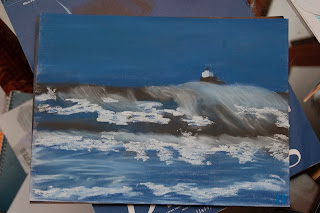
Here's what I did on Sunday, instead of grading papers.

A couple weeks ago, I found my box of pastels in a closet of craft supplies (what, you don't have a closet for craft supplies?  I have two. :)  Well, one and a half.  Anyhow...).  I pulled them out and figured I'd eventually do something with them.  So last night, with a couple photographs for inspiration, I laid down some pigment on paper.


(sorry for the weird angle on that)


and


There's a lot I don't love about them, but they were really quick one-offs that I didn't spend too much time getting technically right.  But, hey, it's something.


11 October 2008

Sunflowers

Shoulder to shoulder,
preened and ready,
necks craned for
their first glimpse.

Suffocating clouds.
Delayed arrival.

Love's threadbare clothing
goes unnoticed.

Could they ever think
he might not come
to court again
tomorrow?


05 October 2008

My Latest Project

Ha ha - well, the latest project I've actually finished.  The scrollwork is a little shaky, but it's not bad, considering I was balanced upon crutches to do it. 

Jess's Birthday Cake!


01 October 2008

Stuff Jen Likes II

In no particular order:

Subways and trams.


Jeremy Irons in Lolita.

Eyewear.

Semicolons.

The ice at Tijuana Flats.

Blackberry fragrances, like Sephora Mure andTrish McEvoy #9.

Cheese fondue.

Used books and used book sales.


Dances with steps (e.g. Electric slide, most ballroom dances).

Chivalry.  Hey, I like a door held open for me.

Dill weed.

Fountain cherry cokes with extra cherry syrup.

Birthdays.

Cotton candy.  (Jelly Belly cotton candy jelly beans are really good, too.)

Sicilian Creme from The Cheese Shop, Indianapolis.


Mint chip ice cream - but only if it's green.

29 September 2008

Mothers and Sons

I don't really have anything profound to say about these works that have caught my eye lately, other than to note that they've caught my eye.  

For all my romantic notions about everything else that urges me to rush in to it like the proverbial fool, the harsh light of reality glints off of parenting.  And these two items have stuck with me for a few weeks now.  I don't know why, haven't really examined it.  Well, that's not true.  I just haven't processed these completely, is all.


Iron & Wine, Upward Over the Mountain

Billy Collins, The Lanyard


20 September 2008

Gone Bananas

I've had quite the taste for banana bread lately - some is in the oven now! I've yet to try a bread that beats my mother's recipe (which goes back at least another generation). Rich banana flavor, deep brown crust, freezes well. And it's very easy to make uninspiring banana bread unless you know the rules:

Good things come to those who wait. If your bananas aren't at least a week old, don't turn on the oven. Seriously - they need to be *black*. Overripe bananas make all the difference in flavor. Personally, I don't like fresh bananas if they're much past the green-tinged stage, so once they turn completely yellow, I just hang on to them and let them get all rotten for killer banana bread.

Good things again come to those who wait. Wait until the next day to eat the final product. Even with a great loaf, waiting a day for flavors to meld keeps the bread from being one-dimensional. This is a particularly handy trait - I often make miniature loaves and freeze them. They usually taste better than fresh loaves.

Don't underestimate the importance of salt. Salt in sweet baked goods brightens the flavors and again ensures multidimensional flavor instead of one-note tropical sweetness. My mother always used (salted) margarine. I use unsalted butter and beef up the pinch of salt. Some salted butter or margarine on top of a slice is a nice salty-sweet counterpoint.

Don't forget about sour, either. Sour milk is specific to my mom's recipe; it doesn't show up in most others. I haven't conducted an experiment yet in which I evaluate the flavor of a batch made with sour milk and one without - but I have to think it contributes to the flavor. It probably keeps the bread from drying out. And it allows the use of baking soda instead of baking powder, and I can usually tell when a recipe requires too much baking powder.

Anyhow, give this a try. And if you're feeling kicky, toss in some toasted coconut before baking.

Mom's Banana Bread

1 1/2 c. sugar
1/2 c. unsalted butter, softened
2 eggs, beaten
4 T. sour milk*
1 t. baking soda
2 c. flour
1 c. mashed banana (2 bananas) - must be exceedingly ripe
1 t. vanilla
1/4 t. salt

Combine butter and sugar, then mix in eggs, milk, and vanilla. Add bananas, soda, flour, and salt. Pour into greased loaf pan(s) and bake at 350 degF until dark golden on top and a toothpick inserted in the center comes out clean.


* Add a splash of vinegar to 4T. milk. Stir, and set aside for 10 min to thicken.


13 September 2008

Listening

My playlist for cleaning the kitchen and pantry, repotting my kitchen basil, and baking a tres leches cake.  

How Will He Find Me, The Weepies
Cacophony, Tilly & The Wall
Shimmer, Fuel
Our God Reigns, Brandon Heath
Where I Began, Caedmon's Call
Hope to Carry On, Caedmon's Call
The Man Who Sold the World (MTV Unplugged), Nirvana
All I Want Is You, U2
Englishman in New York, Sting
All This Time, Sting
Sister, The Nixons
A Girl Like You, Edwyn Collins
The Love That You Had, Tracy Chapman
Innocent Bones, Iron & Wine
Old Friends (Concert in Central Park), Simon & Garfunkel
Under the Milky Way, The Church
Not An Addict, K's Choice
Wolves at Night, Manchester Orchestra
Grounds for Divorce, Wolf Parade


12 September 2008

Bathtub Families

This week, I attended a poetry reading by Poet Laureate Billy Collins.  

He easily would have been one of my favorite professors in college.  I had been introduced to his work by a friend a couple years ago, but I was only familiar with a few of his poems - most notably The History Teacher.  What a delightful evening!  I know this is obvious, but it's one thing to read a poem on a page, and very much another thing to hear the author's inflection as he intended... they are more immediate, more accessible.  And some of his poems are hysterical.  There was one, in particular, that I now have a pretty big crush on. 


Bathtub Families

is not just a phrase I made up
though it would have given me pleasure
to have written those words in a notebook
then looked up at the sky wondering what they meant.

No, I saw Bathtub Families in a pharmacy
on the label of a clear plastic package
containing one cow and four calves,
a little family of animals meant to float in your tub.

I hesitated to buy it because I knew
I would then want the entire series of Bathtub Families,
which would leave no room in the tub
for the turtles, the pigs, the seals, the giraffes, and me.

It's enough just to have the words,
which alone make me even more grateful
that I was born in America
and English is my mother tongue.

I was lucky, too, that I waited
for the pharmacist to fill my prescription,
otherwise I might not have wandered
down the aisle with the Bathtub Families.

I think what I am really saying is that language 
is better than reality, so it doesn't have
to be bath time for you to enjoy
all the Bathtub Families as they float in the air around your head.


from Ballistics (2008)


I have a reputation for recording and collecting clever turns of phrase (or at least instructing someone else to write it down!).  So while a friend thought we were being called out on our behavior, I took the justification path - "no, look, Billy Collins's persona does it too!"  The difference is that I would have bought the Bathtub Family to keep around my house.  Much like I did the Bag of Plagues at Publix one passover season.  Maybe it would have been sufficient to keep the Bag of Plagues in the air around my head.


And I can't walk down the halls of our school anymore without giggling at spurious acclamations of praise.

Oh, My God!

Not only in church
and nightly by their bedsides
do young girls pray these days.

Wherever they go,
prayer is woven into their talk
like a bright thread of awe.

Even at the pedestrian mall
outburst of praise
spring unbidden from their glossy lips.

from Ballistics (2008)


Other highlights (links when I can find 'em):

Serenade

How Poets Read Prose (published as Searching)


04 September 2008

Sunset


Tonight's sunset was beyond stunning! Like, stop-everything-leave-the-food-cooking-on-the-stove-and-go-outside-and-gawk beautiful.

26 August 2008

First Day

Today was my 24th First Day of School. Granted, most of those were as a student! Nevertheless, it's time for a new start, time for another cycle of catch-and-release.

I was reminded of my first day as a teacher of teenagers. It was a significant career change, so I had a lot to prepare. I spent so much time and energy preparing for that first first day: syllabi, lesson plans, my classroom arrangement, seating charts, policies and procedures for everything. I wrote, printed, and copied everything for the day, did some demos, and gave my introductions; that night, I pulled off my suit, and fell - exhausted - into bed when it dawned on me: how was I ever going to do this 179 more times?! What had I gotten myself into? I wonder whether this is what new parents feel - nine months spent preparing for the arrival of a child and panic sets in when you take her home and realize your job has only begun. Anyhow, I made it through that day, that week, that year. And several more first days since.

I'm reasonably pleased with my schedule and very happy with some changes to the department and my courseload. I hope this auspicious First Day gives way to a Good Year.

28 July 2008

Old Friends/Bookends

Paul Simon

Old friends
Old friends
Sat on their park bench
Like bookends
A newspaper blown through the grass
Falls on the round toes
Of the high shoes
Of the old friends
Old friends
Winter companions
The old men
Lost in their overcoats
Waiting for the sun
The sounds of the city
Sifting through trees
Settles like dust
On the shoulders
Of the old friends
Can you imagine us years from today
Sharing a park bench quietly?
How terribly strange to be seventy
Old friends
Memory brushes the same years
Silently sharing the same fears...

Time it was, and what a time it was, it was
A time of innocence, a time of confidences
Long ago, it must be, I have a photograph
Preserve your memories; they're all that's left you